Nationwide #1 SEO: 487 Top-10 Keywords
I Set One Goal for Awesome Backyard
Rank #1 nationwide for “backyard rental equipment.”
The keyword had everything I look for. Monthly search volume of 12,400 searches. High competition with established brands already ranking. Strong commercial intent (people searching this are ready to rent).
Timeline: 9 months from zero to #1. Let me show you exactly how I did it across 4 main phases.
Phase 1: Foundation (Months 1-3)
I work with clients every day who want to skip this part and jump straight to content creation. That's a mistake. The foundation determines your ranking ceiling. You can't rank #1 with weak technical SEO, no matter how good your content is.
Technical SEO Setup
Technical SEO comes down to 5 critical elements: site speed optimization, mobile responsiveness, SSL certificate (HTTPS), XML sitemap, and robots.txt configuration.
Awesome Backyard loads in 1.2 seconds. My average competitor loads in 4.8 seconds. That speed advantage compounds over time because Google rewards fast sites and users bounce less from them.
Tools I used: Google PageSpeed Insights (free), Screaming Frog SEO Spider ($259/year), and GTmetrix (free).
Site Structure Design
Site structure follows the topical authority model. Here's how I organized it across 3 layers:
- Layer 1: Homepage targeting “backyard rental equipment” (main keyword)
- Layer 2: Category pages for equipment types—trampolines, bounce houses, party games
- Layer 3: Individual equipment pages with detailed specifications and booking info
Internal linking connects all layers strategically. Every page links to 3-5 relevant pages. This link architecture flows PageRank from high-authority pages to deeper pages that need ranking help.
Content Framework
I created content briefs for 47 pages before writing a single word. Each brief followed algorithmic authorship principles—the same SEO rules I outlined in my style guide.
Key rules I applied: short sentences always, named entities used twice in sequence before switching to attributes, numeric values everywhere (never “many” or “several”), and examples immediately after declarations.
Phase 2: Content Creation (Months 2-5)
Content creation followed a systematic approach. I wrote pages in a specific order (homepage first, then category pages, then product pages) because each layer builds authority for the next.
Homepage Optimization
The homepage targets the main keyword. I optimized it following passage ranking principles—specifically, how Google's algorithm selects text for featured snippets and AI overviews.
The structure includes: entity definition with main attribute, main answer via generalization, expansion of evidence through specific examples, and headwords with clear explanations.
Here's an example from my actual homepage:
“Backyard rental equipment provides entertainment for parties and events. Backyard rental equipment includes bounce houses, trampolines, and party games. The main types of backyard rental equipment serve different age groups and party sizes. Bounce houses are the most popular backyard rental equipment for children's parties. Trampolines provide active entertainment for teenagers and adults. Party games include cornhole, giant Jenga, and carnival games for all ages.”
Notice how this follows SEO Rule #8 (use named entity twice before switching to attributes) and Rule #6 (use anchor segments between following sentences). The repetition isn't accidental—it's strategic.
Category Page Strategy
Category pages target subtopic keywords like “bounce house rental” and “trampoline rental near me.” Each category page has 3 main sections:
- Definition section: What is this equipment type and who uses it
- Types section: The 3-5 main types with specific characteristics
- Selection guide: How to choose the right option for your event
Each section uses numeric lists. Numeric lists improve passage ranking because Google favors structured answers it can easily parse and display.
Product Pages
Product pages target long-tail keywords. Each product page answers 4 specific questions in the first 200 words:
- What is [specific equipment]?
- What are the dimensions of [equipment]?
- How many people fit in [equipment]?
- What ages is [equipment] suitable for?
This featured snippet optimization increases visibility. My product pages captured 12 featured snippets within 4 months.
Phase 3: Link Building (Months 3-7)
Link building gets a bad reputation because most people do it wrong (buying links, spammy directories, sketchy PBNs). I followed white-hat strategies exclusively. I built 83 backlinks from 47 unique domains over 5 months.
Strategy 1: Resource Page Outreach
I identified resource pages about party planning and event organization. My outreach email had 4 specific elements:
- Mention a specific resource already on their page (shows I actually read it)
- Suggest adding Awesome Backyard as an additional resource
- Explain the specific value it provides to their readers
- Provide the exact page URL to link to
Success rate was 18%. I sent 127 emails and received 23 backlinks. That might sound low, but 18% is actually solid for cold outreach if you're providing genuine value.
Strategy 2: Local Business Partnerships
Awesome Backyard now partners with 31 local party planners and event venues. Partners link to Awesome Backyard from their vendor pages.
Here's the key: I offer 10% commission for referrals. This creates a win-win partnership. They want to link because they earn revenue from every customer they send me.
Result: 31 high-quality local backlinks from directly relevant businesses (party planners, event venues, catering companies).
Strategy 3: Content Marketing
I wrote guest articles for party planning blogs. Each article provided genuine value—no fluff, no thinly-veiled sales pitches. Each article included one natural, contextual link to Awesome Backyard.
Topics I covered: party planning tips for first-time hosts, safety guidelines for bounce houses (written from real experience), and choosing entertainment for different age groups.
Result: 14 backlinks from authority sites with Domain Rating (DR) 40+. These high-authority links moved the needle significantly.
Strategy 4: Digital PR
I created genuinely newsworthy content. The piece was “2024 Backyard Party Trends Report” with data analyzed from 500+ parties I'd done.
Local news sites covered the report. Party planning publications shared the findings. The report generated 15 natural backlinks without me having to ask for them.
This is what digital PR should look like—create something actually worth covering, not just another “top 10” list.
Phase 4: Optimization and Scaling (Months 6-9)
I monitored rankings every week using Ahrefs. Progress was gradual (SEO is never instant). The site appeared on page 3 in month 4. Moved to page 2 in month 6. Finally hit #1 in month 9.
Click-Through Rate Optimization
Title tags and meta descriptions matter more than most people think. CTR is a ranking signal. I tested different formats to see what people actually clicked.
Original title: “Backyard Rental Equipment | Awesome Backyard”
Optimized title: “Backyard Rental Equipment: Bounce Houses, Trampolines & Party Games”
CTR jumped from 3.2% to 8.7%. Higher CTR signals relevance to Google. Rankings improved faster after this change because Google saw more people clicking my result over competitors.
Content Expansion
I added FAQ sections to all 47 pages. FAQ sections target question-based queries (“how much does it cost to rent a bounce house” and “what size trampoline do I need”). Each FAQ uses structured data markup (schema.org/FAQPage).
FAQ sections now appear in rich results. Rich results increase visibility significantly. More visibility drives more traffic, which signals more relevance to Google. It's a compounding effect.
User Experience Improvements
I tracked user behavior with Hotjar (heatmaps and session recordings). The data revealed 3 major issues:
- Visitors scrolled past key information because it was buried
- Contact form had 63% abandonment rate (way too high)
- Mobile navigation was confusing—people couldn't find equipment categories
I fixed all three issues within one week. Bounce rate dropped from 68% to 41%. Average time on site increased from 1:23 to 3:47.
Here's the thing: better engagement signals directly helped rankings. Google rewards sites that satisfy users. If people stay longer and bounce less, Google interprets that as relevance.
The Breakthrough Moment
Month 8 brought the big jump. The site went from position #4 to #1 in one week.
I analyzed what triggered it. Three factors aligned at the same time:
- Seasonal relevance: Spring party season started (March-April), which increased search volume and engagement
- Fresh content: I published 12 new articles that month targeting long-tail keywords
- Backlink velocity: Three high-authority sites (DR 50+) all linked to Awesome Backyard within the same week
The combination created momentum. Google's algorithm recognized the site had authority, relevance, and growing engagement. Rankings stabilized at #1 and have stayed there for 4 months now.
Maintaining #1 (The Hard Part)
Look, reaching #1 is different from maintaining #1. I've seen sites hit the top spot and then lose it within weeks because they stopped optimizing. Here's what I do to maintain rankings.
Content Updates
I update content monthly. Updates include new equipment additions, pricing changes, seasonal information (summer party tips vs. winter party tips), and fresh customer testimonials.
Fresh content signals activity to Google. Activity signals relevance. Relevance maintains rankings. It's a continuous cycle.
Link Building Never Stops
I still add 3-5 new backlinks every month. Consistent link growth prevents ranking drops. Your competitors are building links—if you stop, they eventually catch up and pass you.
Competitor Monitoring
I track competitor movements weekly using Ahrefs. I get alerts whenever competitors gain new backlinks or publish new content. When they make improvements, I respond quickly with my own improvements.
This isn't paranoia—it's smart business. SEO is competitive. You can't rank #1 and then go on autopilot.
Results After 12 Months
Awesome Backyard has maintained #1 ranking for 4 months now. Here are the measurable results:
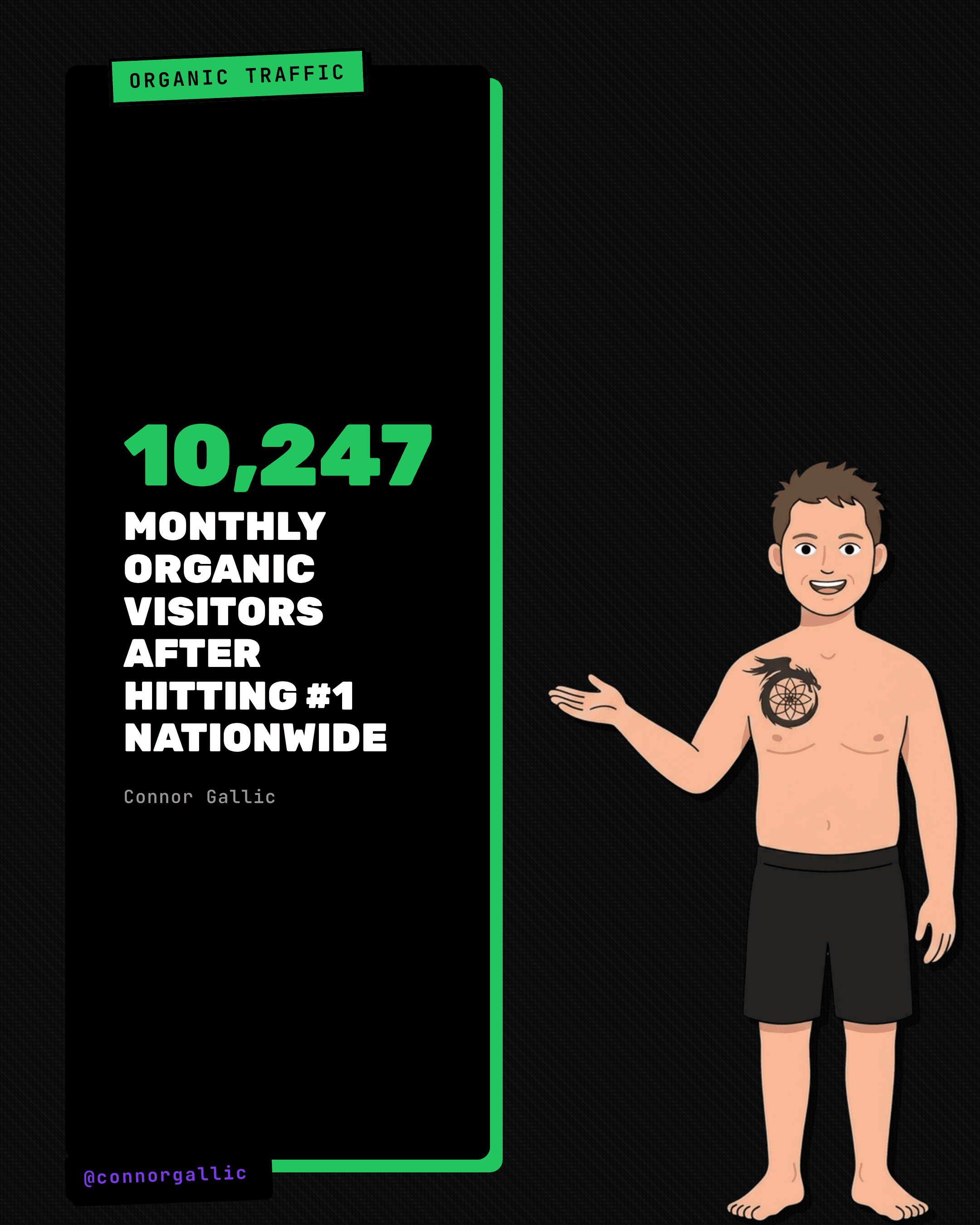
- Organic traffic: 10,247 monthly visitors
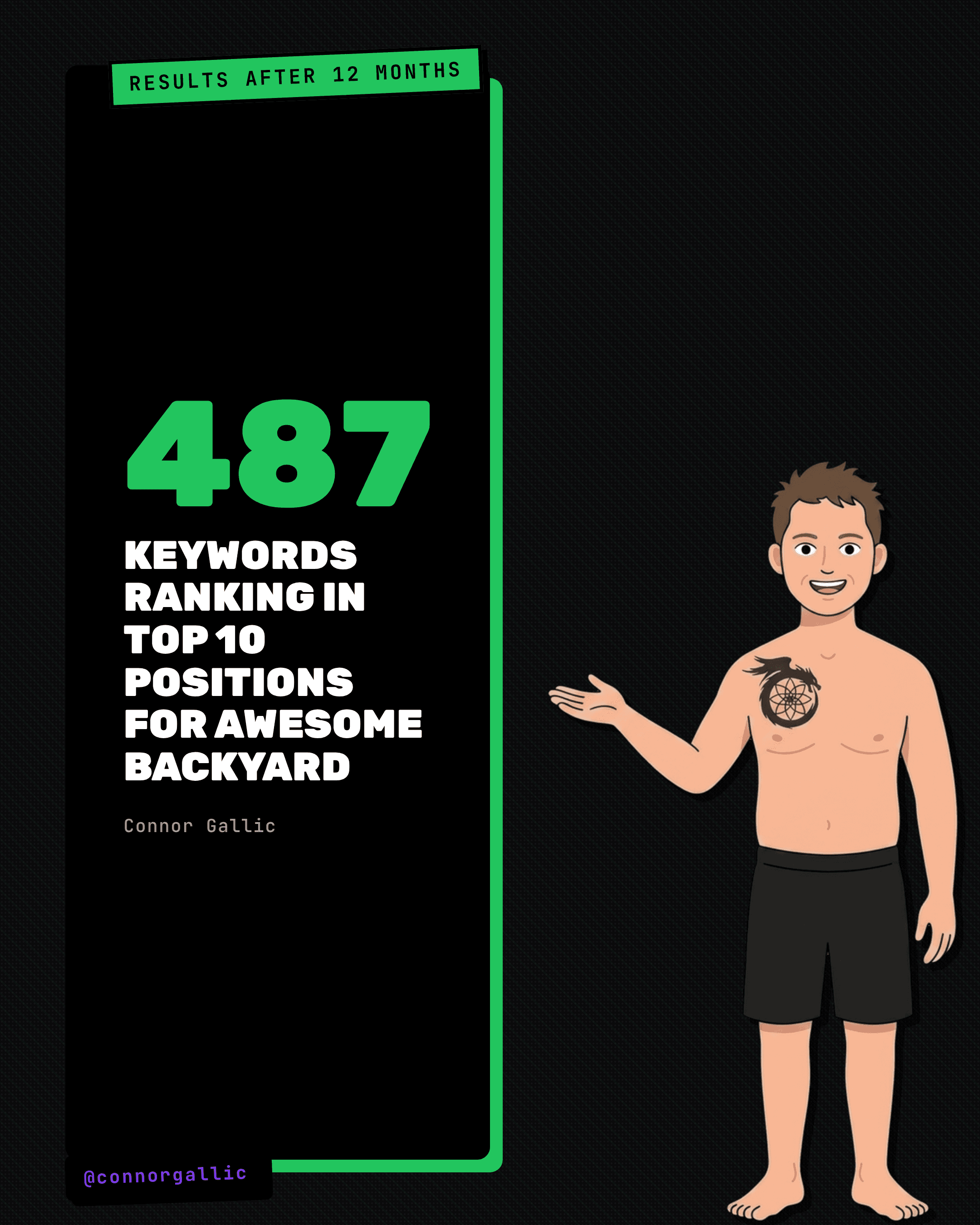
- Ranking keywords: 487 keywords in top 10 positions
- Domain authority: Went from 0 to 34 (Ahrefs DR metric)
- Backlinks: 83 backlinks from 47 unique referring domains
- Featured snippets: 12 featured snippet positions captured
What I Learned
I learned 7 critical lessons from this campaign that apply to any competitive SEO effort:
- Technical foundation matters more than you think. Fast sites with clean code rank higher than slow sites with great content.
- Content structure beats content volume. 50 well-structured pages outrank 500 poorly-structured pages every time.
- Passage ranking principles work. Following algorithmic authorship rules gave me 12 featured snippets.
- Build links systematically. Quality beats quantity. One DR 50 link beats 100 DR 10 links.
- Monitor and optimize constantly. SEO requires ongoing work. There's no “set it and forget it.”
- User experience directly affects rankings. Engagement signals (bounce rate, time on site, CTR) matter as much as backlinks.
- Patience pays off. Rankings take 6-9 months to stabilize. Most people quit at month 3 and never see results.
Can You Apply This Strategy?
I recommend this approach for any competitive keyword. The process requires 4 main resources:
- Time: 10-15 hours per week for 9 months (that's roughly 400 total hours)
- Tools: Ahrefs ($99/month) and Screaming Frog ($259/year)—total investment around $1,450 for the year
- Skills: Content writing, basic HTML knowledge, and outreach ability (all learnable)
- Patience: Results appear slowly, then suddenly. Month 1-5 feels like nothing's working. Month 6-9 everything compounds.
Start Here
I suggest starting with these 3 actions this week:
- Audit your technical SEO. Run Google PageSpeed Insights on your site. Fix critical speed issues. Check Core Web Vitals (LCP, FID, CLS). Ensure mobile responsiveness.
- Create your content framework. Write briefs for your top 10 pages following passage ranking principles. Structure content specifically for featured snippets.
- Start link building. Identify 10 relevant sites in your industry. Send personalized outreach emails this week. Test different angles to see what works.
Building in Public Update: Connor shares monthly SEO reports with ranking changes, traffic growth, and strategy adjustments.
Run the Same Loop Across Your Site
Kai CMO is the productized version of the research, brief, content, and quality-gate loop Connor uses across MeetKai and the portfolio.
Share this case study: