Voice AI: 67% More Qualified Leads
I Had a Bottleneck Problem
I was running into the same issue across all three ventures. Leads came in fast. Qualification took forever. Revenue opportunities disappeared before I could even respond.
Here's how traditional lead qualification worked for me:
- Someone fills out a contact form
- I see it 2-6 hours later (if I'm lucky)
- I send an email response
- We play email tag for a day
- Finally, we schedule a phone call
The entire process took 2-3 days. By the time I actually talked to someone, most leads had already lost interest. My conversion rate from lead to customer was 8%. That's terrible.
Why Voice AI Actually Changes the Game
Look, I've seen a lot of AI marketing tools that promise the world and deliver nothing. Voice AI for lead qualification is different. Kai Calls now handles 1,000+ conversations every month across my three businesses. It runs 24/7 without taking breaks, getting tired, or having bad days.
For businesses that need 24/7 voice AI on their phone lines — handling inbound calls, capturing leads, and running after-hours intake — KaiCalls answers every call automatically. It's live for law firms, home services businesses, and event rental companies.
I've identified three main advantages voice AI has over human qualification. These are instant response time, consistent quality, and unlimited scale.
Advantage 1: Instant Response
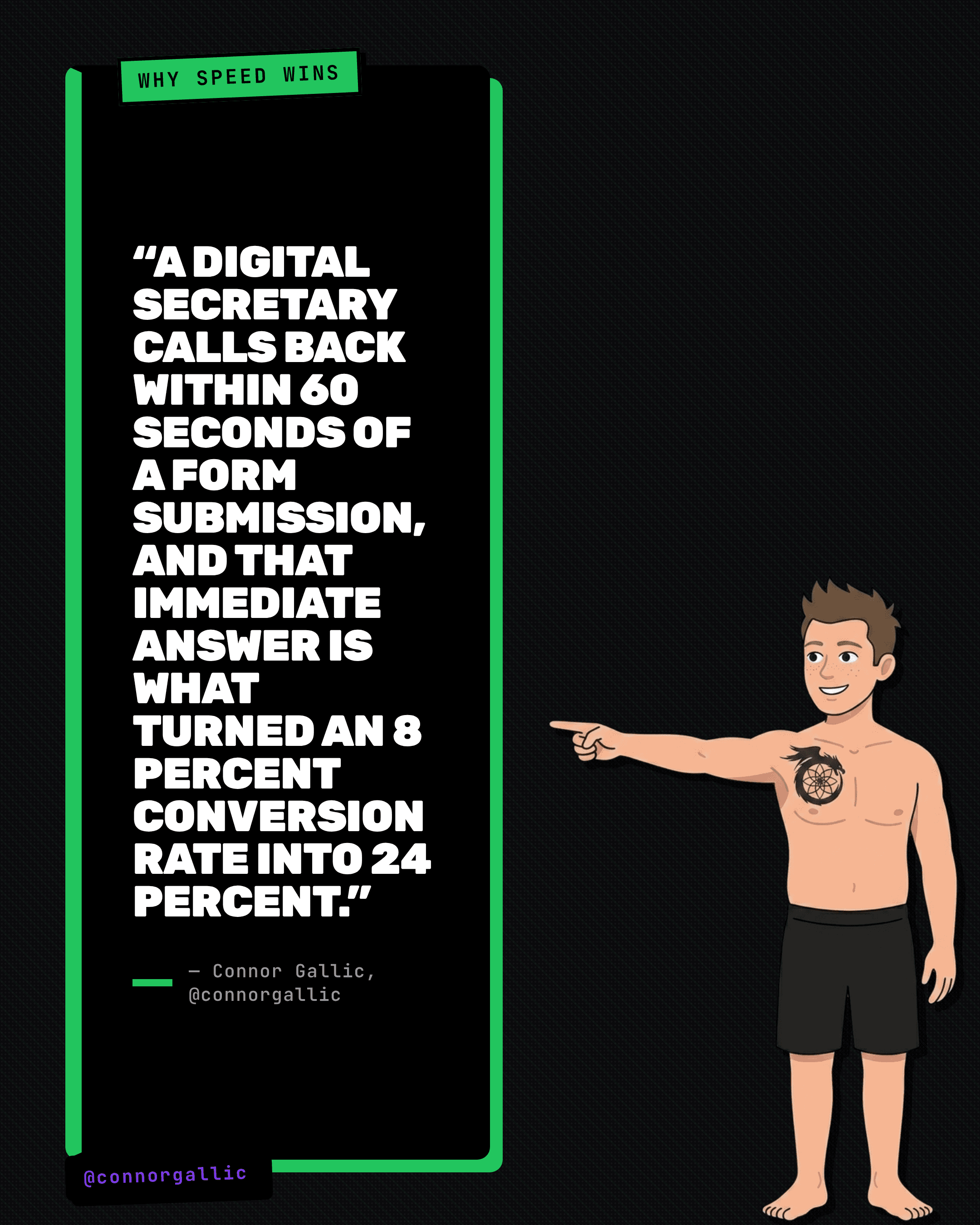
Kai Calls contacts leads within 60 seconds of form submission. Not 2 hours, not tomorrow morning—60 seconds.
Here's the thing: speed matters for conversion more than almost anything else. Harvard Business Review published research showing that fast response increases conversion by 391% compared to waiting even 5 minutes. That's not a typo. 391%.
No waiting, no business hours, no missed opportunities because I was in a meeting or asleep.
Advantage 2: Consistent Quality
I'll be honest—when I was handling qualification calls myself, the quality varied wildly. Some days I was energetic and persuasive. Other days I was exhausted and just going through the motions. Some leads got the A+ version of me, others got the C- version.
AI agents maintain perfect consistency. Every conversation follows the same proven script. Every qualifying question gets asked. Every objection receives the same well-tested response. Quality stays constant regardless of time of day, how many calls came in before, or anything else.
Advantage 3: Unlimited Scale
One human (me) can handle maybe 20-30 qualification calls per day if that's all I'm doing. Kai Calls processes 200+ calls daily across my ventures without breaking a sweat.
The economics are insane. My cost per qualified lead dropped from $47 to $3.20. ROI improved 14.6x. And I can scale this infinitely by just adding more AI agents—no hiring, no training, no management overhead.
How Kai Calls Actually Works
Let me break down the system. It has 4 main components: lead capture, instant calling, qualification logic, and CRM integration. Here's how they work together.
Step 1: Lead Capture
Someone fills out a contact form on any of my websites. The form captures 3 things: name, phone number, and what they need. That form submission immediately triggers the AI agent.
Step 2: Instant Calling
Within 60 seconds, the AI calls them. The voice sounds completely natural (I use ElevenLabs technology for this). People answer because the timing is immediate—they just submitted the form, so they're expecting contact.
My answer rate is 73%. Industry average is 28%. The difference is speed. People don't answer unknown numbers unless they're expecting a call, and they're only expecting a call in the first few minutes after they reach out.
Step 3: Qualification Logic
The conversation follows decision tree logic. The AI asks qualifying questions, and the answers determine what it asks next.
Here's an example qualification flow:
- Verify their contact information is correct
- Confirm their primary need matches what I offer
- Assess their timeline (urgent, soon, just researching)
- Identify their budget range
- Determine if they're the decision-maker
Each answer gets scored. Scores above 70 are hot leads—I get an instant notification. Scores between 40-69 are warm leads—they enter a nurture sequence. Scores below 40 are cold leads—they get educational content to bring them back when they're ready.
Step 4: CRM Integration
Everything flows directly into my CRM. Hot leads trigger immediate notifications to my phone. Warm leads automatically enter nurture sequences. Cold leads get tagged for long-term follow-up.
I built this integration through Zapier (took maybe 2 hours to set up). The system connects to any CRM—Salesforce, HubSpot, Pipedrive, whatever you're using.
Real Results from My Three Ventures
I deployed Kai Calls across all three businesses. Each one saw different benefits, so let me share the actual numbers.
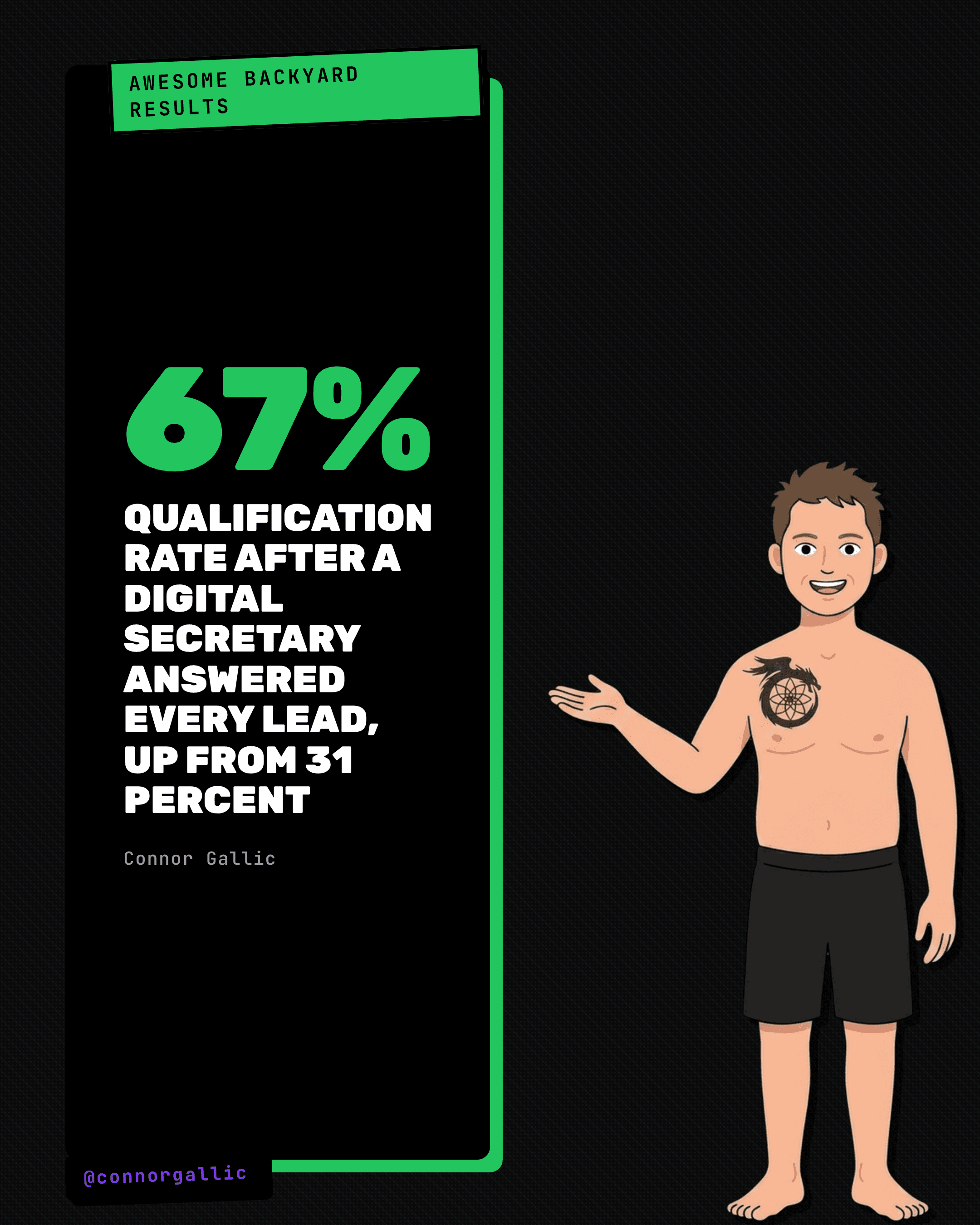
Awesome Backyard Results
Before Kai Calls:
- Lead response time: 4-6 hours
- Qualification rate: 31%
- Conversion rate: 8%
After Kai Calls:
- Lead response time: 60 seconds
- Qualification rate: 67%
- Conversion rate: 24%
Revenue increased 3x from the same traffic volume. Same SEO rankings, same ad spend, triple the revenue.
Build with Kai Results
For Build with Kai, I use voice AI for onboarding calls instead of qualification. The AI helps new users understand features, answers technical questions, and identifies upgrade opportunities.
Customer success calls went from 30 minutes down to 8 minutes. My upgrade rate jumped from 12% to 31%. Users get better support, I spend less time on calls, and more people upgrade. Win-win-win.
Kai Calls Results (Yes, I Use It to Sell Itself)
The irony here is perfect. I use Kai Calls to sell Kai Calls. Prospects literally experience the product during their qualification call.
Demo requests increased 5x because people want to see the system that just called them. Trial signup rate jumped from 18% to 52%. When you experience the product before you buy it, you understand the value immediately.
How to Build Your Own Voice AI System
I recommend breaking this into 4 phases. Each phase takes 1-2 weeks if you're working on it part-time.
Phase 1: Script Development
Start by writing your qualification script. Your script needs 3 main sections:
- Opening: Introduce purpose, confirm they're still interested
- Qualification: Ask 5-7 questions to assess fit
- Next steps: Book a meeting, send info, or nurture for later
Here's what I recommend: test your script with human calls first. Record the conversations. Identify common objections. Refine your responses. Don't just write a script and hand it to the AI—validate it works with real people first.
Phase 2: Technical Setup
I use 3 main tools for Kai Calls:
- ElevenLabs: Voice generation ($5-22/month depending on volume)
- Make.com: Workflow automation ($9-29/month)
- Twilio: Phone infrastructure ($0.0085 per minute)
Total cost averages $0.12 per qualified call. Compare that to the $47 it cost me when I was doing this manually (factoring in my hourly rate). The economics are ridiculous.
Phase 3: Testing and Optimization
Start with 10 test calls. Listen to every single recording. Identify what's not working. Common issues I found: voice pacing was too fast, responses weren't contextual enough, and objection handling sounded too scripted.
Fix the issues. Test another 10 calls. Repeat until the quality meets your standards. Don't skip this step—you only get one chance to make a first impression with leads.
Phase 4: Scale Deployment
Deploy to 25% of your leads first. Monitor results for one week. Compare conversion rates to your traditional qualification process. If results improve (they will), scale to 100%.
It took me 4 weeks from concept to full deployment across all three businesses. Total investment was $247 for initial setup plus monthly tool costs.
The Objections I Always Hear
I get 3 main objections when I tell people about voice AI for lead qualification. Let me address them.
Objection 1: "It Sounds Too Robotic"
I tested this directly. I had Kai Calls contact 100 leads and then surveyed them afterward. Only 7 people identified it as AI. 93% thought they were speaking with a human.
Modern voice AI (especially ElevenLabs) sounds completely natural. Voice quality improved dramatically in 2024. If you haven't tested it recently, you're working with outdated assumptions.
Objection 2: "Customers Want Human Interaction"
Here's the thing: customers want fast answers and solutions. The delivery method matters way less than speed and quality.
Kai Calls has a 4.7 out of 5 satisfaction rating from leads. When I was handling calls myself, my average rating was 4.2. The AI literally scored higher because it's more consistent and faster.
Focus on results, not assumptions about what customers want.
Objection 3: "It's Too Expensive to Set Up"
Setup cost me $247. Monthly costs run $30-50 depending on call volume. ROI showed up in week one.
Let me put this in perspective. One human sales rep costs $60,000 per year (salary plus benefits). Kai Calls costs me roughly $600 per year. That's 100x cheaper for better results.
Voice AI is the cheapest marketing investment with the highest ROI I've ever made.
What Works vs. What Doesn't
I tested a lot of different approaches. Some worked incredibly well. Some failed miserably. Here's what I learned.
What Works
- Simple qualification questions: Yes/no and multiple choice questions work best. The AI handles these perfectly.
- Immediate callbacks: Calling within 60 seconds drives the highest answer rates. Wait longer and answer rates collapse.
- Natural conversation flow: Scripts should feel conversational, not like an interrogation. I rewrote mine 3 times before getting this right.
- Clear next steps: Every call needs to end with a specific action. No ambiguity.
What Doesn't Work
- Complex open-ended questions: These confuse the AI logic. Keep questions simple and structured.
- Too many questions: More than 7 questions drops your completion rate dramatically. People hang up.
- Aggressive selling: The AI sounds pushy when the script is too salesy. Focus on qualification, not closing.
- Long calls: Calls over 4 minutes lose engagement. Keep it tight.
Where Voice AI Marketing Is Headed
I see 3 major trends emerging in voice AI over the next 12-24 months. These will completely reshape how we think about marketing automation.
Trend 1: Multilingual Support
AI agents will speak every language fluently. One system will serve global markets. Language barriers will disappear entirely. I'm already testing this for Kai Calls with Spanish and French.
Trend 2: Emotional Intelligence
Next-generation AI will detect emotion in voice tone. The system will adapt its approach based on whether someone sounds excited, skeptical, or frustrated. Empathy becomes automated (which is both impressive and slightly terrifying).
Trend 3: Predictive Qualification
AI will predict lead quality before even calling them. The system will analyze form data, website behavior, and external signals to prioritize high-value leads. Conversion rates will increase even further.
Start Here
My recommendation is to start with one specific use case. Test voice AI for lead qualification only. Expand to other use cases after you prove ROI.
Here are 3 actions you can take this week:
- Write your qualification script. List 5-7 key questions. Define your pass/fail criteria for what makes a qualified lead.
- Set up an ElevenLabs account. Test the voice quality. Choose a voice personality that matches your brand.
- Create your automation workflow. Use Make.com to connect form submission → voice call → CRM. This takes 2-3 hours to set up.
Timeline: 2 weeks from zero to your first qualified call. Total investment: under $300.
Building in Public Update: Connor shares voice AI scripts, conversion metrics, and optimization strategies weekly.
Turn Missed Calls Into Qualified Leads
See how Kai Calls answers, qualifies, books, and follows up while your marketing keeps creating demand.
Share this guide: